 EN
EN
 English
  简体中文
简体中文  Italian
  Spanish
  Turkish
  Japanese
  Portuguese
  Russian
  French
  German
  Polish
  Persian
  Arabic
 News
Latest news, updates & insights from Fushi.
Latest news, updates & insights from Fushi.
Sep 22, 2026Source:Intelligent Browse: 2
Field computing often requires more than simply putting a desktop operating system into a smaller device. When a tablet is used for equipment inspection, vehicle applications, industrial automation, outdoor patrol, or medical workflows, the processor and operating system need to work within a hardware platform that can handle temperature changes, dust, water, drops, and continuous mobile use.
The combination of Intel Celeron N5100 and Ubuntu 22.04 gives the RT-10U 10-inch Ubuntu22.04 Rugged Tablet a practical foundation for these applications. Instead of focusing only on processing specifications, this configuration connects computing performance with rugged protection, wired and wireless connectivity, sunlight-readable display options, GPS positioning, and field-oriented expansion.
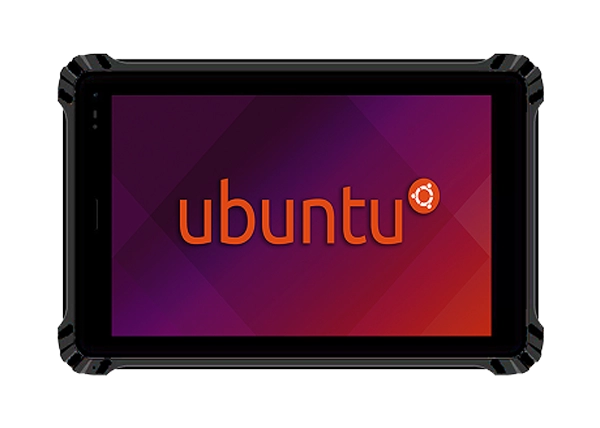
The Intel Celeron N5100 is a quad-core, four-thread processor with a clock range of 2.20 GHz to 2.80 GHz. For a rugged tablet, this provides a useful computing platform for applications that require more than basic data entry or communication.
The processor is paired with Ubuntu 22.04 rather than a mobile-focused operating system. This distinction matters when the tablet needs to run software developed for Linux-based industrial environments, embedded applications, automation systems, or customized enterprise software.
The RT-10U supports memory configurations of 8GB + 128GB, 16GB + 128GB, and 16GB + 256GB. These options allow system builders and project teams to match memory and storage capacity to their software workload instead of using one fixed configuration for every deployment.
For example, a field application that mainly collects inspection records may have different storage requirements from a system that stores images, local databases, maps, or other operational data.
Operating system selection can influence how easily a rugged tablet fits into an existing technical environment.
Ubuntu 22.04 can be useful when an organization already uses Linux-based development tools, applications, scripts, databases, or industrial software. Rather than redesigning the software environment around a mobile operating system, developers can deploy compatible Linux applications directly on the tablet platform.
This is particularly relevant for applications involving intelligent manufacturing, automation, vehicle systems, equipment monitoring, and specialized data collection.
The operating system is only one part of deployment, however. A field tablet also needs appropriate interfaces and communication hardware. This is where the hardware configuration of the RT-10U becomes important.
A 10-inch display provides a compromise between portability and workspace. Smaller screens can make industrial software interfaces difficult to operate, while larger panels can become inconvenient when technicians need to carry the device around a facility or vehicle.
The standard display resolution is 800 × 1280, with a 1200 × 1920 option available. Standard brightness is 500 nits, while 800-nit and 1000-nit options are also available.
This brightness range gives project designers more flexibility when the tablet is used in different lighting conditions. For outdoor or vehicle applications, a higher-brightness configuration can be considered when screen visibility is a key requirement.
The display also supports 10-point touch input and has a 7H hardness rating. This makes the interface suitable for applications where operators need to interact directly with software while moving between workstations, equipment, or outdoor locations.
Industrial computing hardware is often exposed to conditions that standard consumer tablets are not designed to handle.
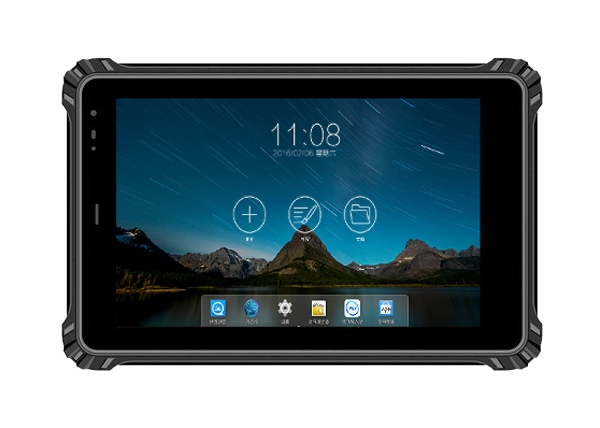
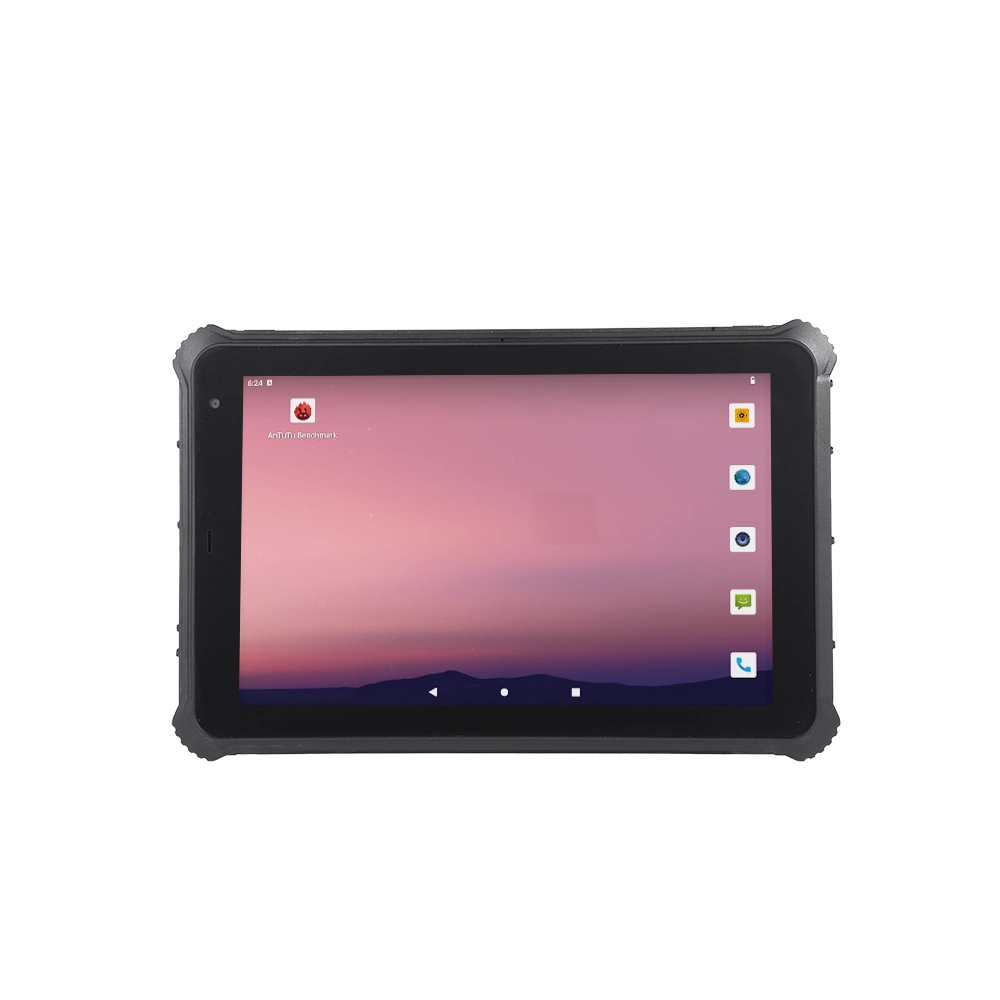
The RT-10U 10-inch Ubuntu Rugged Tablet uses a dual-color molded enclosure and provides IP67 protection. The IP67 design is particularly relevant to field applications where dust and water exposure are part of the working environment.
Its specified operating temperature range is -20°C to 60°C. The storage temperature range extends from -30°C to 70°C, while the specified humidity is up to 95% non-condensing.
These specifications make the tablet suitable for projects that involve significant temperature variation between indoor and outdoor environments.
The device is also specified as 1.2-meter drop-resistant on a composite wooden floor and supports MIL-STD-810H certification. For field teams, these mechanical and environmental specifications can be more important than simply comparing processor numbers.
A rugged tablet becomes much more useful when it can communicate with the surrounding equipment and network infrastructure.
The RT-10U supports 802.11a/b/g/n/ac Wi-Fi on 2.4 GHz and 5.8 GHz frequencies. It also includes Bluetooth 5.1 BLE Class 1 connectivity with a transfer distance of up to 10 meters.
For applications that operate beyond local Wi-Fi coverage, 4G and 5G communication are available as optional configurations.
This combination can support different deployment models. A tablet may use Wi-Fi inside a factory, Bluetooth to communicate with nearby peripherals, and cellular connectivity when technicians move into remote areas.
The device also includes a 100 Mbps Ethernet port. This is useful when the tablet needs to connect to wired industrial networks, test equipment, or local infrastructure instead of relying entirely on wireless communication.
Positioning becomes important when the tablet is used outside a fixed workstation.
The RT-10U supports a GPS module, allowing applications to associate collected information with a geographic position. This can be useful in outdoor inspection, vehicle applications, field service, patrol operations, surveying-related workflows, and other location-dependent tasks.
A rugged tablet with integrated positioning can reduce the need for a separate GPS device when location data is part of the software workflow.
For example, a field application can be designed to associate inspection records with the operator's current location. In vehicle applications, positioning information can also become part of a larger operational or fleet-related software system.
Industrial tablets often need more physical interfaces than consumer tablets.
The RT-10U provides a Micro HDMI interface, USB Type-A, USB Type-C, a 3.5 mm audio interface, Ethernet, DC input, a 12-pin pogo pin connector, TF card slot, and SIM slot.
The TF card interface supports storage of up to 1TB according to the product specification. The pogo pin connector can also provide a practical connection point for compatible accessories or docking configurations.
Optional modules further expand the platform. Depending on the project, configurations can include 4G/5G communication, fingerprint modules, NFC, RFID, and 1D/2D barcode scanning.
This modular approach is useful for OEM projects because the requirements of a medical device, warehouse terminal, vehicle system, and public safety application are not necessarily the same.
A rugged tablet used outside a fixed workstation needs sufficient battery capacity for its intended workflow.
The device uses a built-in 7.6V 6000mAh polymer lithium-ion battery. The specified battery life is up to 8 hours under the stated test condition of 50% volume while playing 1080P local high-resolution video.
Actual operating time will depend on the workload, screen brightness, wireless communication, GPS use, peripheral connections, and software activity.
The loadable battery design is also positioned around longer field operation. For projects where charging opportunities are limited, battery configuration should be evaluated together with application workload rather than relying on a single nominal runtime figure.
The hardware combination is suited to several environments where Linux computing and rugged construction need to coexist.
In intelligent manufacturing, the tablet can serve as a mobile interface for operators, inspection personnel, or equipment-related applications. Ethernet, USB, wireless communication, and a 10-point touchscreen provide several ways to connect the computing platform with the surrounding system.
For oil and gas operations and outdoor inspection, IP67 protection, wide temperature support, GPS, and optional cellular communication become more relevant. Operators can use the tablet as a mobile computing terminal rather than carrying separate communication and positioning equipment.
Vehicle applications can benefit from the combination of GPS, Ethernet, USB, cellular communication options, and a rugged enclosure. Medical and law enforcement applications can also use optional modules such as fingerprint identification or barcode scanning where project requirements call for additional identification or data capture functions.
Choosing a rugged tablet should start with the software and working environment rather than the enclosure alone.
If the application requires Linux compatibility, the Intel N5100 and Ubuntu 22.04 combination provides a clear starting point. Memory and storage can then be selected according to the software workload.
Next, the project team can determine whether 500 nits is sufficient or whether an 800-nit or 1000-nit display is more appropriate. Wireless requirements should be defined separately, including Wi-Fi, Bluetooth, GPS, and optional 4G or 5G.
For field deployment, IP67 protection, the -20°C to 60°C operating range, drop resistance, battery capacity, and MIL-STD-810H certification should also be considered together.
Finally, interfaces and optional modules should be matched to the equipment or workflow that the tablet will actually support.
The value of the RT-10U is not based on Intel N5100 or Ubuntu 22.04 alone. Its practical role comes from combining the processor and operating system with a rugged hardware platform, multiple interfaces, wireless communication, GPS, expandable storage, and optional application-specific modules.
Fushizk Technology Co.,Ltd focuses on rugged computing products for industrial, medical, transportation, automation, energy, outdoor inspection, and other specialized environments. Its technical capabilities cover embedded system development, AI algorithm optimization, and wireless communication technology, supporting customized rugged computing projects.
For applications that need Linux software compatibility but also require protection against demanding field conditions, the RT-10U 10-inch Ubuntu22.04 Rugged Tabletoffers a defined hardware and software platform. With Intel N5100 processing, Ubuntu 22.04, IP67 protection, a wide operating temperature range, flexible connectivity, GPS support, and optional expansion modules, it can be configured around the practical requirements of industrial and mobile computing deployments.