 EN
EN
 English
  简体中文
简体中文  Italian
  Spanish
  Turkish
  Japanese
  Portuguese
  Russian
  French
  German
  Polish
  Persian
  Arabic
 News
Latest news, updates & insights from Fushi.
Latest news, updates & insights from Fushi.
Aug 26, 2026Source:Intelligent Browse: 67
Domestic Beidou positioning can give rugged tablets a practical advantage in field operations where location accuracy, equipment identification, and reliable data collection need to work together.
When a tablet is used indoors, its location may not be especially important. A technician can simply walk to a known workstation, connect to the local network, and complete the required task. Field operations are different. Workers may move between equipment areas, outdoor sites, vehicles, substations, warehouses, or infrastructure facilities where knowing exactly where a task was performed can be an important part of the record.
This is where positioning becomes more than a navigation feature. For industrial tablets, location data can become part of equipment inspection, asset management, field service, transportation, and public-sector workflows.
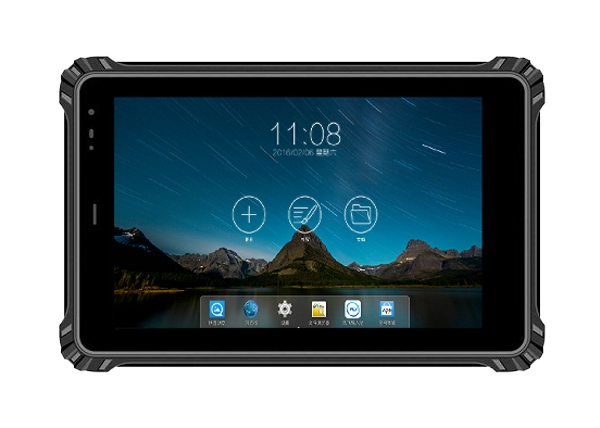
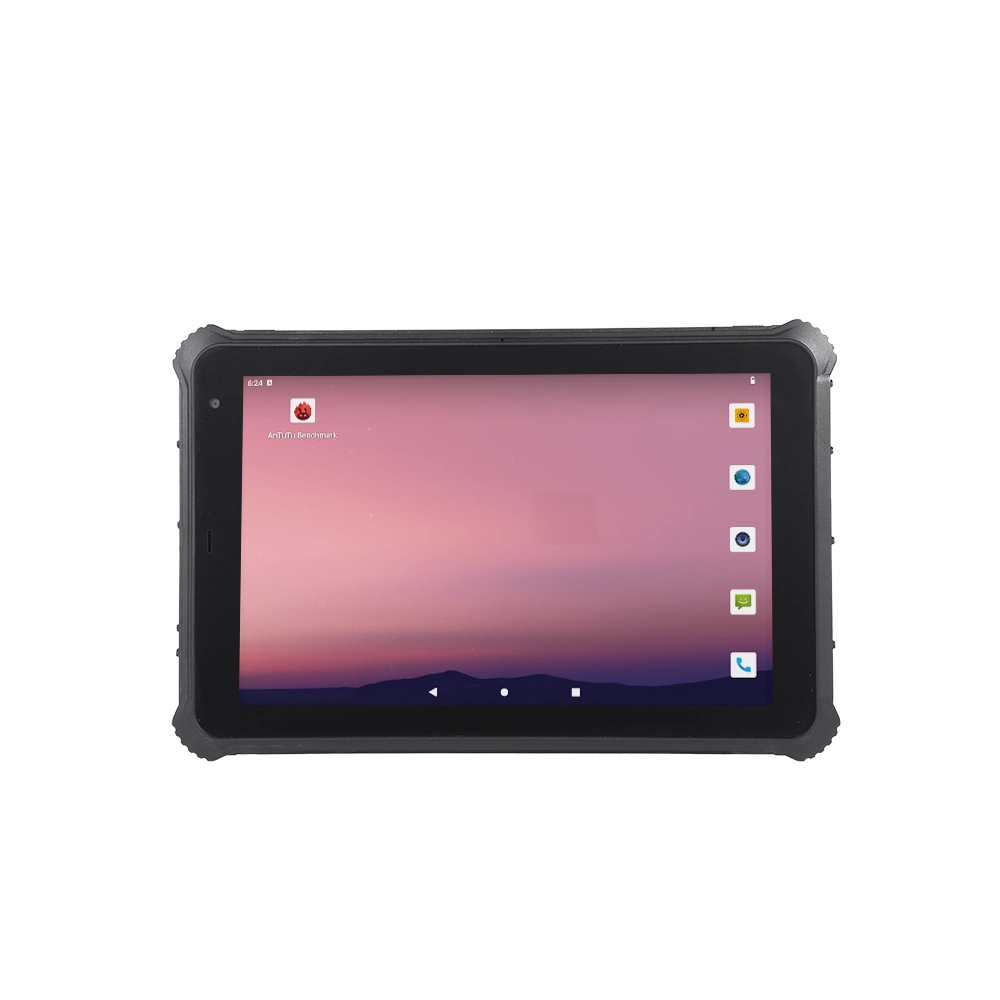
The RT-08RA is an 8-inch Android 14 domestic rugged tablet designed for this type of connected field operation. It uses a domestic standalone Beidou positioning configuration and can be equipped with optional RTK high-precision positioning or other customized positioning modules.
Many mobile devices use satellite positioning as a background function. For an industrial tablet, however, positioning can be directly connected to the work being performed.
Consider an inspection technician checking equipment across a large industrial site. The technician may need to record the equipment number, inspection result, photographs, and location. If the tablet can provide positioning information, the inspection record can contain more useful field context.
This is especially practical when equipment is distributed across large areas. A maintenance manager reviewing inspection records later can distinguish between similar assets based not only on an asset ID but also on where the inspection took place.
The RT-08RA supports domestic standalone Beidou as its standard positioning option. For projects requiring greater positioning precision, its configuration can be upgraded with domestic standalone Beidou, RTK high-precision positioning, or customized GNSS modules.
This makes the device suitable for projects where positioning requirements vary from basic location recording to more demanding field applications.
A rugged tablet does not need to replace a dedicated surveying instrument to benefit from accurate positioning.
In many industrial workflows, the requirement is more straightforward: confirm where an asset is located, associate a work order with a field location, or help an operator identify the correct work area.
For example, a utility maintenance team may have equipment spread across several outdoor locations. A technician receives a digital work order and travels to the assigned point. The tablet's positioning function can help verify the work location before the inspection begins.
The same principle can be applied to infrastructure inspection. A field worker can collect photographs and inspection notes while the application associates the information with the relevant geographic position.
This reduces reliance on handwritten location descriptions such as “near the north gate” or “behind building three.” Instead, the inspection system can use structured location information that is easier to organize and retrieve.
Standard satellite positioning is sufficient for many location-based tasks, but some projects require much greater precision.
RTK, or Real-Time Kinematic positioning, is designed for applications where higher positioning accuracy is needed. On a rugged tablet, an RTK module can be useful when the device is part of a field data collection system rather than simply being used for navigation.
Potential applications include surveying support, infrastructure inspection, engineering projects, agricultural operations, mapping-related work, and high-precision asset positioning.
The RT-08RA can be configured with an RTK high-precision positioning module. This gives project integrators the option to build a more specialized field terminal without changing to a completely different device platform.
The exact positioning performance in the field will depend on the selected module, correction service, satellite visibility, environmental conditions, and application design. Therefore, RTK should be selected based on the actual accuracy requirement of the project rather than simply being added as a specification.
Location data becomes more useful when it is connected to the correct asset.
This is why industrial tablets often need more than GPS or Beidou. A field technician may have to identify a piece of equipment before accessing its digital inspection form.
The RT-08RA can be equipped with several identification options, including NFC, HF/LF RFID, UHF RFID, ID card reading, and 1D/2D barcode scanning.
For example, a warehouse operator could scan a barcode to retrieve an asset record. A maintenance worker could use an RFID tag to identify equipment without manually entering a long serial number. In another project, NFC could be used for short-range identification at a designated inspection point.
UHF RFID provides another option for applications where the operator does not need to place the tablet directly against the tag. The available UHF configurations specify reading distances of approximately 3–5 meters or 10–15 meters depending on the selected module.
When these functions are combined with Beidou positioning, the workflow can become much more structured:
This is a much more practical use of positioning than simply displaying a point on a map.
Location information has limited value if field data cannot be transferred to the system that needs it.
The RT-08RA supports Wi-Fi 6-class connectivity through 802.11a/b/g/n/ac/ax across 2.4GHz, 5.8GHz, and 6GHz bands. An additional Wi-Fi module can also be added for specific project requirements.
For mobile projects, optional 4G or 5G communication can provide another way to transfer inspection data outside fixed wireless networks.
The tablet also includes a Gigabit Ethernet port. This is particularly useful in industrial environments where a wired network connection is preferred for commissioning, equipment communication, testing, or fixed workstation use.
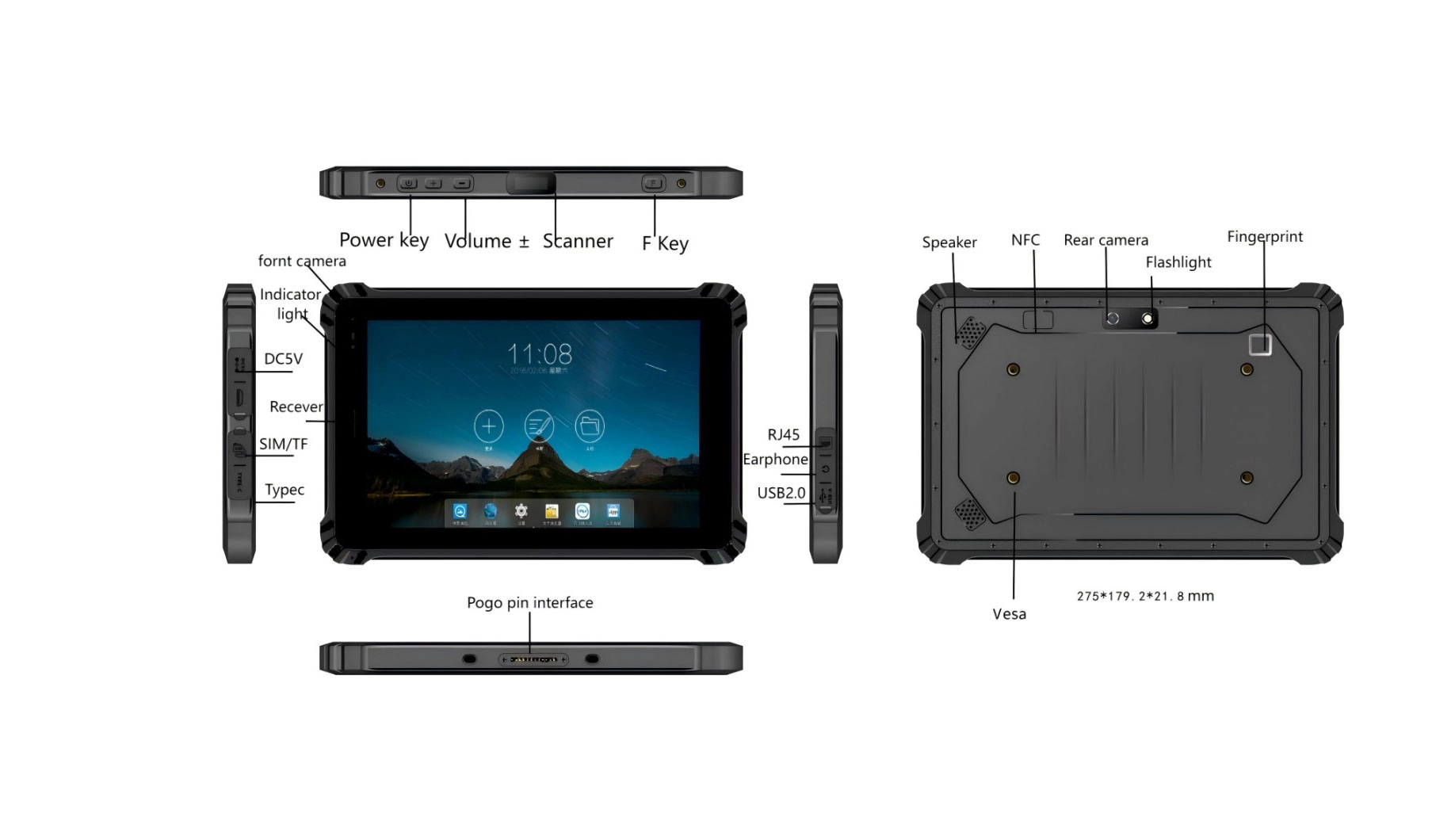
Its USB 3.1 Type-A, USB 3.0 Type-C, Mini HDMI, Pogo Pin, SIM, and TF interfaces provide additional connection options for different system configurations.
This combination means the tablet can move between different operating environments without being limited to one communication method.
Positioning equipment is often used outside, which means the tablet itself needs to cope with outdoor conditions.
The RT-08RA has an IP67 protection rating and is designed to operate from -20°C to 60°C. It also undergoes a 1.2-meter drop resistance test on a composite wood floor.
These characteristics matter because positioning-enabled tablets may be carried around construction sites, utility facilities, transportation areas, industrial yards, or other locations where accidental drops, dust, moisture, and temperature changes are realistic operating conditions.
The 8-inch form factor also provides a useful balance between screen area and portability. At approximately 226 × 145 × 21.8 mm and 760 g, the tablet can be carried by a technician while still providing enough display space for digital forms, maps, equipment information, and inspection applications.
The display can be configured for 500, 800, or 1000 nits, which gives project teams options when the tablet will be used under stronger ambient light.
The positioning capability becomes particularly interesting when the tablet is integrated into a vehicle-based system.
The RT-08RA has two aviation plugs that can be modified for functions such as vehicle power supply, network connection, serial communication, and other project-specific requirements.
For fleet inspection, mobile service vehicles, transportation systems, or specialized industrial vehicles, this can allow the tablet to operate as part of a larger onboard system.
A vehicle-based maintenance team, for example, could use the tablet to identify the current vehicle or assigned equipment, access work orders, record service information, and associate activities with positioning data.
In this situation, the tablet is not simply a portable computer. It becomes an operator interface connecting the field worker, vehicle, equipment, positioning system, and backend application.
Positioning applications often need to run alongside other software functions. An inspection worker may have a map open while also using a camera, asset management application, browser, or communication software.
The RT-08RA uses an RK3588 octa-core processor with a main frequency of 2.4GHz and runs Android 14. Memory configurations include 8GB+128GB, 8GB+256GB, and 16GB+256GB, with expandable SSD storage from 128GB to 2TB.
For system integrators, this gives more room to build applications that combine location services with image capture, databases, asset identification, and communication functions.
The 13MP front and rear cameras, with LED support on the rear camera, can also support field documentation. A technician can record equipment conditions directly from the same device used for positioning and inspection.
Not every project needs the same positioning configuration.
For routine asset inspection, a domestic standalone Beidou module may be sufficient. If the project requires higher positioning precision, an RTK configuration should be considered.
The communication module should also match the operating environment. Wi-Fi may be suitable for plants and facilities with stable wireless coverage, while 4G or 5G can be more practical for mobile outdoor operations.
Similarly, RFID, NFC, UHF, and barcode scanning should be selected according to how assets are identified in the existing management system.
This modular approach is important for B2B projects because the best rugged tablet configuration is not necessarily the one with the largest number of features. It is the one that fits the actual workflow without adding unnecessary hardware.
As a Shenzhen-based technology company, Fushizk Technology Co.,Ltd focuses on rugged computing products for factory automation, measurement equipment, environmental monitoring, power systems, transportation, outdoor inspection, and IoT applications.
The company combines rugged tablet development with embedded system development and wireless communication technologies. Its R&D investment and patent development also support customized hardware configurations for different industrial projects.
For organizations developing domestic field systems, this type of customization can be useful when the tablet needs to work with existing equipment, communication networks, positioning systems, or identification technologies.
Beidou positioning is most valuable when it becomes part of a complete field workflow.
For industrial inspection, asset management, vehicle systems, infrastructure maintenance, and other outdoor operations, a rugged tablet can combine positioning with identification, communication, image capture, and application software to create a more traceable working process.
The RT-08RA brings these capabilities together in an 8-inch Android 14 platform with domestic standalone Beidou, optional RTK positioning, Wi-Fi, optional 4G/5G, Gigabit Ethernet, RFID and scanning options, IP67 protection, and vehicle-oriented interface possibilities.
For projects that need a domestic rugged tablet with positioning at the center of the workflow, the RT-08RA provides a practical hardware platform that can be configured around the actual field application rather than forcing the application to fit a fixed device.