 EN
EN
 English
  简体中文
简体中文  Italian
  Spanish
  Turkish
  Japanese
  Portuguese
  Russian
  French
  German
  Polish
  Persian
  Arabic
 News
Latest news, updates & insights from Fushi.
Latest news, updates & insights from Fushi.
Sep 24, 2026Source:Intelligent Browse: 2
Mobile work often becomes difficult when a tablet has to remain active for an entire shift but charging opportunities are limited. Technicians may move between equipment, vehicles, warehouses, outdoor sites, or inspection points without returning to a fixed workstation. In these situations, battery capacity is only part of the solution. The ability to remove and replace the battery can also affect how easily a rugged tablet fits into a continuous field workflow.
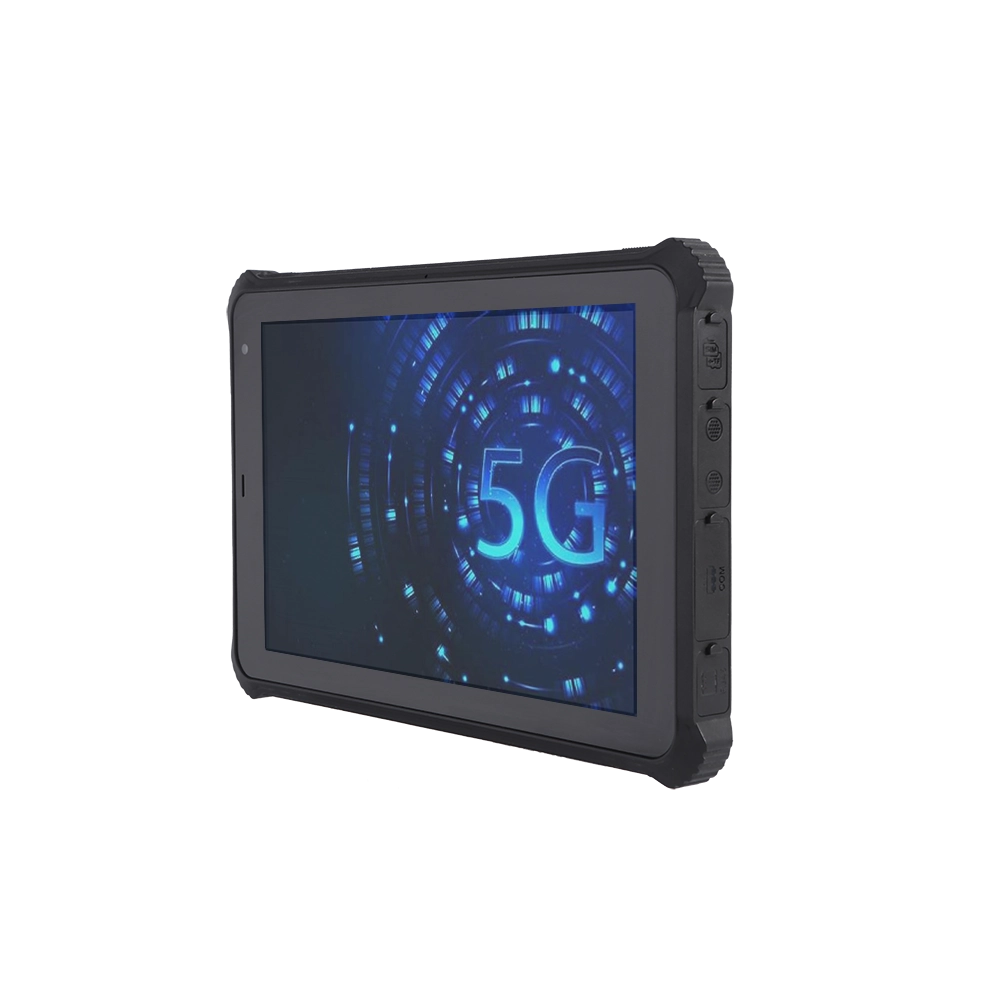
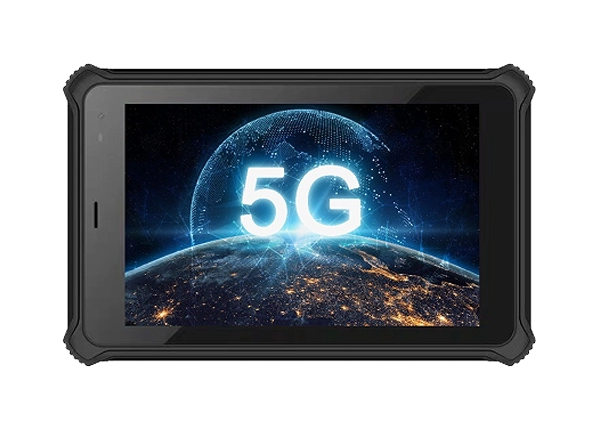
The RT-08D9 8inch Android14 5G Rugged Tablet combines a detachable 8500mAh polymer lithium-ion battery with 5G connectivity, multi-system positioning, IP67 protection, and a compact 8-inch form factor. This combination gives mobile teams a practical platform for applications where the tablet needs to stay connected and operational while moving between different work locations.
A fixed battery can be sufficient for office-based tablet use, where charging stations are normally available. Field operations are different. A technician may spend several hours inspecting equipment before returning to a vehicle or service station, while a patrol officer may need the device throughout a shift.
A detachable battery changes the way the tablet can be managed. Instead of making the entire tablet unavailable while charging, a project can be designed around battery replacement.
The RT-08D9 uses a 3.8V 8500mAh detachable polymer lithium-ion battery. For organizations deploying multiple tablets, this also creates the possibility of managing spare batteries separately from the devices themselves.
This can be useful when tablets are shared between shifts or when operators work in locations where access to power is inconsistent.
The specified battery life of the RT-08D9 is 8 hours under a defined test condition: 50% volume while playing 1080P local high-definition video.
This figure provides a reference point rather than a guaranteed runtime for every application. Actual battery consumption will depend on the workload.
For example, continuous 5G communication, GPS or other positioning functions, high screen brightness, camera use, barcode scanning, and processor-intensive applications can all affect power consumption. A tablet mainly used for viewing documents may have a different operating profile from one continuously transmitting data over a cellular network.
For project planning, the 8-hour specification can therefore be used as a baseline while the actual application should be tested under its expected working conditions.
The detachable design becomes particularly relevant when several operators use the same type of tablet.
Consider a maintenance team working across multiple shifts. Instead of assigning each tablet to a fixed charging schedule, the organization can maintain charged spare batteries and replace them when necessary.
This approach can reduce interruptions caused by low battery levels during active work.
The same principle can apply to warehouse operations, vehicle-based service, outdoor inspection, and public safety applications. When the tablet is part of a larger operational workflow, the ability to manage power separately from the device can provide additional flexibility.
The RT-08D9 8inch Android14 5G Rugged Tablet is therefore designed around more than battery capacity alone. The detachable battery is one component of a mobile computing platform intended to keep field activities moving.
Battery management is closely related to connectivity. A tablet that is used away from a fixed network may need to transmit inspection results, retrieve records, communicate with a remote system, or synchronize information while the operator is moving.
The RT-08D9 supports 2G, 3G, 4G, and 5G communication, with a broad range of LTE and NR bands listed in its specifications.
This makes the tablet suitable for applications where Wi-Fi is not always available. An operator can potentially use cellular communication while working across different areas of a facility, traveling between sites, or operating in outdoor environments.
The tablet also supports Wi-Fi 6-compatible 802.11a/b/g/n/ac/ax connectivity across 2.4GHz, 5.8GHz, and 6GHz frequencies. Bluetooth 5.3 BLE Class 1 provides another option for connecting compatible peripherals.
For a mobile workflow, having several communication methods means the device does not have to depend on a single network type.
Mobile workflows often involve more than data transmission. The location where information is collected can also be important.
The RT-08D9 supports GPS, BeiDou, Galileo, and GLONASS, with one of these positioning options available according to the product configuration. Optional GNSS configurations can also support domestic BeiDou or RTK high-precision positioning.
This can be useful when inspection records, vehicle activities, patrol events, or field service data need to be associated with a geographic position.
For example, an outdoor inspection application could record the location of an equipment check together with photos and inspection data. In vehicle applications, positioning can provide location information for software that uses route or asset data.
The optional RTK configuration is particularly relevant to projects that require higher positioning precision than standard navigation.
An 8-inch rugged tablet occupies less physical space than many larger industrial tablets while still providing a larger working area than a smartphone.
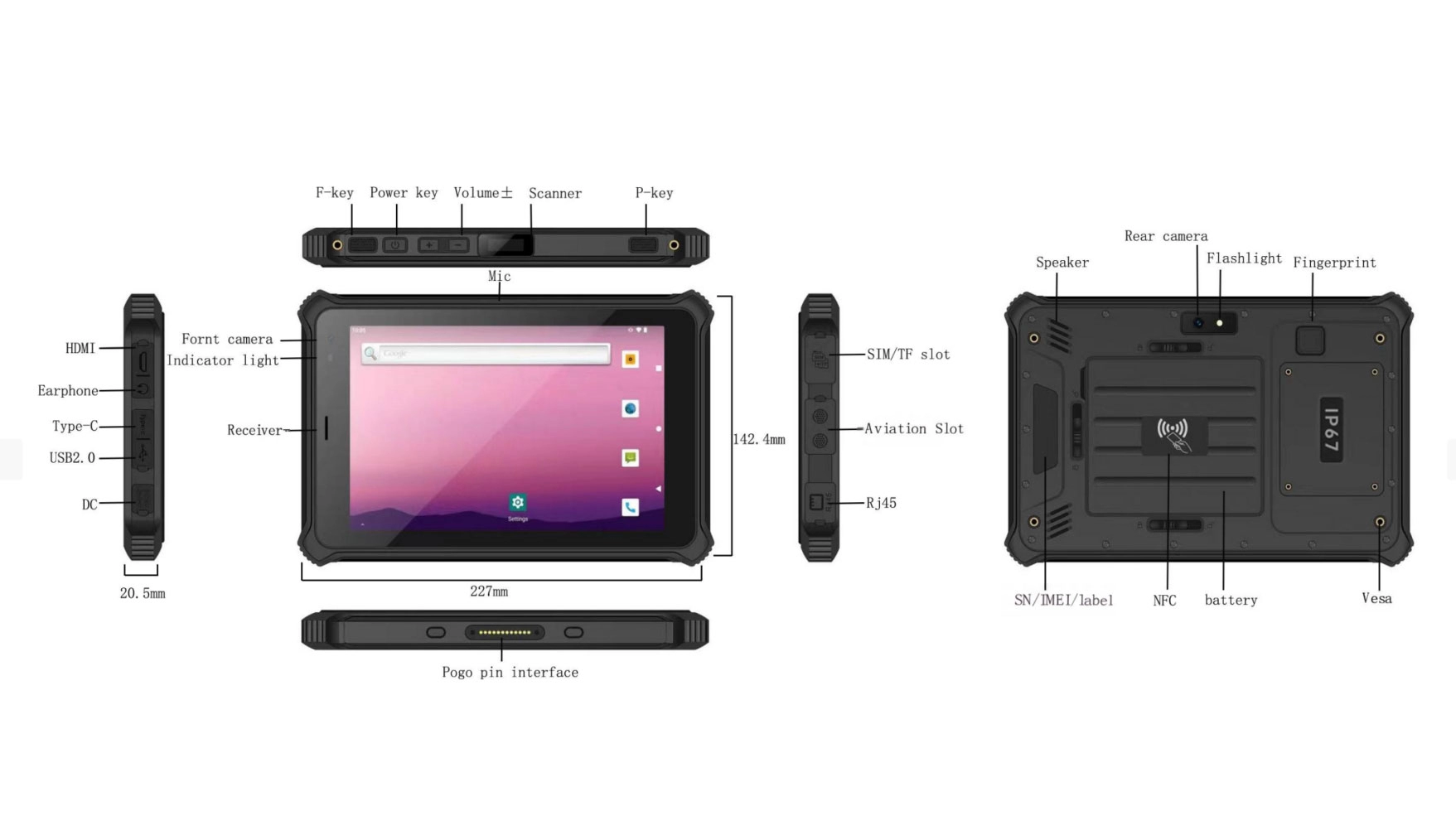
The RT-08D9 measures 226 × 145 × 21.8 mm and weighs approximately 760 g. This makes its physical dimensions relevant when the device needs to be carried while the operator is walking, climbing, inspecting machinery, or working around a vehicle.
The 8-inch screen has an 800 × 1280 standard resolution, with 1200 × 1920 available as an option. Brightness can be configured at 500, 800, or 1000 nits depending on project requirements.
These display options can be matched to different working conditions rather than using the same configuration for every deployment.
The tablet supports 10-point touch input with a 7H touch panel. Optional configurations can include anti-glare, glove touch, and wet-hand touch functions.
These options matter when the operator cannot use the touchscreen in the same way as someone working at a desk.
For example, a technician wearing work gloves may need a glove-compatible interface, while outdoor workers may encounter moisture on the screen. An anti-glare configuration can also be considered when strong ambient light affects screen visibility.
This makes the touch panel another component that should be selected according to the actual workflow rather than treated as a standard specification.
Mobile work frequently involves identifying equipment, materials, people, or documents.
The RT-08D9 supports optional 1D/2D QR code scanning modules and can be configured with NFC, RFID, fingerprint, and offline ID card modules.
For warehouse or manufacturing workflows, a scanner can allow an operator to identify an item and retrieve its associated information directly on the tablet.
RFID can support applications involving tagged assets, while NFC can be used for compatible identification and communication tasks. Fingerprint and ID card options can be considered for applications that require user or identity verification.
The tablet therefore has the potential to combine data collection, communication, positioning, and identification in one mobile device.
A mobile tablet also needs to withstand the environment in which it operates.
The RT-08D9 has an IP67 protection rating and a specified operating temperature range of -20°C to 60°C. Its storage temperature range is -30°C to 70°C, with humidity specified at up to 95% non-condensing.
The device is also specified as 1.2-meter drop-resistant under the stated composite wood floor test condition and lists MIL-STD-810H among its certifications.
These specifications are relevant when the tablet is used outside controlled office environments. Battery flexibility is useful only when the hardware itself can remain operational under the expected working conditions.
The main advantage of a detachable battery becomes clearer when it is considered alongside the rest of the device.
An outdoor technician may use the camera to document equipment, GPS to record location, 5G to transmit information, and a scanner to identify an asset. Each function consumes system resources, while the display and wireless communication also contribute to battery usage.
A detachable 8500mAh battery provides a practical way to manage this power demand during mobile work.
The tablet also includes USB Type-A, USB Type-C, Mini HDMI, a 100 Mbps network port, a SIM card slot, a TF card slot supporting up to 1TB, and two aviation plugs that can be modified for functions such as vehicle power, network, or serial interfaces.
This range of interfaces allows the platform to be adapted to different equipment and installation requirements.
The combination of battery design, communication, positioning, and rugged construction can support several field-oriented applications.
In vehicle applications, the tablet can combine cellular connectivity, GPS, camera functions, and optional vehicle-related interfaces. In outdoor patrol, the compact 8-inch format makes the device easier to carry than larger industrial computers.
For manufacturing and automation, scanning and network connectivity can help operators access equipment or production information at different points on the floor. Oil and gas operations can benefit from the rugged enclosure, wide operating temperature range, positioning capabilities, and cellular communication.
Medical and public-sector applications can also make use of optional identification modules and mobile connectivity when the workflow requires them.
Battery capacity should never be evaluated separately from the rest of the device. A tablet with a large battery but limited connectivity may still require additional equipment. Similarly, strong communication capabilities are less useful if operators cannot keep the device powered during long field activities.
Fushizk Technology Co.,Ltd develops rugged computing products for manufacturing, automation, transportation, medical, energy, outdoor inspection, and other specialized applications. Its technical capabilities include embedded system development, AI algorithm optimization, and wireless communication technology, supporting different application and customization requirements.
For teams that need a compact Android platform with cellular communication, multi-system positioning, rugged protection, and flexible power management, the RT-08D9 8inch Android14 5G Rugged Tablet combines these functions in a 760 g device. Its detachable 8500mAh battery is particularly relevant to workflows where charging interruptions are difficult to accommodate, while 5G, GNSS options, scanning modules, and multiple interfaces allow the tablet to be configured around the actual requirements of mobile operations.