 EN
EN
 English
  简体中文
简体中文  Italian
  Spanish
  Turkish
  Japanese
  Portuguese
  Russian
  French
  German
  Polish
  Persian
  Arabic
 News
Latest news, updates & insights from Fushi.
Latest news, updates & insights from Fushi.
Aug 17, 2026Source:Intelligent Browse: 86
Equipment monitoring rarely happens in a perfectly controlled environment. A technician may need to check a machine on a production floor, monitor equipment at an energy facility, inspect a remote installation, or review operating information beside a piece of machinery. In these situations, the computing device needs to do more than display a dashboard. It needs to connect with equipment, run the required software, collect information, and keep working despite temperature changes, dust, moisture, or accidental drops.
This is where an Ubuntu-based rugged tablet can be useful. Ubuntu 22.04 provides a Linux environment for applications that need local processing, device communication, or customized software, while rugged hardware provides the physical protection needed outside a conventional office.
The RT-08U 8-inch Ubuntu22.04 Rugged Tablet combines Ubuntu 22.04 with an Intel Celeron N5100 processor, multiple interfaces, wireless connectivity, GPS support, optional 4G/5G, and IP67 protection. For equipment monitoring projects, this combination allows the tablet to function as a compact monitoring terminal rather than simply a portable screen.
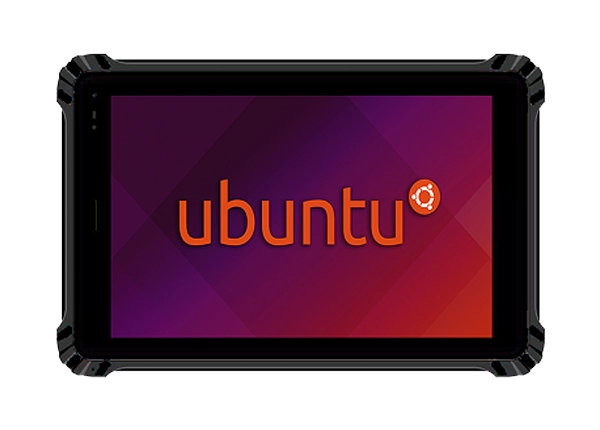
The operating system is an important consideration when the tablet needs to run specialized monitoring software.
Equipment monitoring applications may be developed specifically for Linux or may require access to system-level interfaces and connected devices. Ubuntu is widely used in development environments, embedded systems, edge computing projects, and industrial software, making it a practical platform for organizations that already have Linux-based applications.
The RT-08U uses Ubuntu 22.04 and an Intel Celeron N5100 processor with four cores and four threads. The processor operates at 2.20GHz to 2.80GHz, while memory configurations include 8GB + 128GB, 16GB + 128GB, and 16GB + 256GB.
This gives system integrators flexibility when matching the tablet to the software workload. A basic monitoring application may have modest computing requirements, while a more complex application may need additional memory and storage for local data, logs, or supporting software.
The key point is that the tablet can be configured around the monitoring application instead of requiring the monitoring workflow to fit a consumer tablet.
A monitoring terminal is only useful if it can receive information from the equipment being monitored.
Different machines and systems use different communication methods. Some may rely on Ethernet, while others use USB-connected peripherals or customized interfaces. In some cases, the tablet may need to communicate with local network equipment and then send processed information to a central platform.
The RT-08U provides a 100Mbps Ethernet port, USB Type-A, USB Type-C, Micro HDMI, and a 12-pin Pogo Pin. These interfaces provide several options for connecting external equipment and accessories, depending on the communication requirements of the project.
Ethernet can be particularly useful when a wired network is preferred for stable communication. USB interfaces can support compatible peripherals, while the Pogo Pin provides an option for customized docking or accessory integration.
For example, a monitoring station could use Ethernet to connect the tablet to a local network while the Ubuntu application displays equipment information on the 8-inch screen. The exact communication protocol still needs to be matched to the equipment and software, but having multiple physical interfaces gives developers more flexibility during system integration.
Not every monitoring task requires all raw data to be sent immediately to a remote server.
In some applications, the tablet can receive equipment information, process it locally, display important values, and only transmit selected information to the backend. This can be useful when network bandwidth is limited or when operators need immediate access to equipment status.
The RT-08U can support this type of workflow through its Intel processor, Ubuntu operating system, local storage, and network interfaces.
Consider a machine monitoring application. The tablet could receive operating information from connected equipment, display key readings through a Linux application, store selected records locally, and transmit required data through the available network connection. If an abnormal value is detected, the application could highlight the condition for the operator.
The actual functions depend on the software developed for the project, but the hardware provides a suitable platform for building a local monitoring terminal.
Equipment monitoring does not always take place beside a wired network connection.
A tablet may need to move between different monitoring points or connect to systems where Ethernet is not practical. The RT-08U supports 802.11a/b/g/n/ac Wi-Fi at 2.4GHz and 5.8GHz, as well as Bluetooth 5.1.
Optional 4G or 5G communication can also be configured for projects that require cellular connectivity.
This creates several possible communication methods. Wi-Fi can be used inside facilities with an existing wireless network. Ethernet can provide a wired connection at a fixed monitoring station. Bluetooth can connect compatible nearby devices, while cellular communication can support remote locations.
For a distributed equipment monitoring project, this flexibility can be more useful than relying on a single communication method.
Before deployment, the required network standards, communication protocols, and cellular frequency bands should be checked against the target equipment and operating region.
The size of the screen affects how easily an operator can work with a monitoring application.
A small handheld device may make detailed dashboards difficult to read, while a full-size laptop can be inconvenient when the operator needs to move around equipment. An 8-inch tablet provides a middle ground.
The RT-08U uses an 8-inch LCD display with an 800 × 1280 standard resolution, with a 1200 × 1920 option. Standard brightness is 500 nits, while 800-nit and 1000-nit configurations are available.
The higher-brightness options can be considered for applications where the tablet may be used in bright areas or near outdoor equipment. This is particularly relevant when the operator needs to read status indicators, graphs, equipment parameters, or alarm information without constantly moving the device to a darker location.
The 10-point touch panel has 7H hardness, providing a touchscreen interface suitable for direct interaction with monitoring software.
Equipment monitoring can become more complicated when assets are distributed across multiple locations.
A service organization may monitor equipment installed at different sites, while an energy or transportation company may have assets spread across a larger geographical area. In these cases, knowing where a monitoring record was created can add useful context.
The RT-08U supports a GPS module. With appropriate software, GPS information can be associated with monitoring records, inspection activities, or equipment locations.
For example, an operator could access an equipment record, review its current status, record an observation, and associate the record with the monitoring location. This does not replace a dedicated asset management system, but it can add location information to the data workflow.
For applications where location accuracy requirements are higher, the specific GPS configuration and software capabilities should be evaluated during project design.
Monitoring the correct piece of equipment is just as important as collecting its operating information.
When multiple machines have similar appearances or are installed close together, manually entering asset numbers can introduce errors. Identification modules can simplify this step.
The RT-08U supports optional NFC, HF/LF, RFID, and 1D/2D scanning modules. It supports protocols including 14443A, 14443B, 15693, and 125K, depending on the selected module.
This allows an equipment monitoring workflow to begin with identification. An operator could scan a barcode or use an RFID/NFC method to identify an asset, then allow the Ubuntu application to load the corresponding monitoring information.
The workflow could look like this:
Identify the equipment → open its digital record → review operating information → record findings → save the monitoring result → synchronize the data.
The specific process depends on the customer's software system, but combining identification and monitoring on one rugged terminal can reduce unnecessary manual steps.
A monitoring tablet may spend its working life around equipment rather than inside an office.
The RT-08U has an IP67 protective rating and is designed to withstand a stated 1.2-meter drop onto a composite wooden floor. Its operating temperature range is -20°C to 60°C, with a storage range of -30°C to 70°C. The specified humidity is up to 95% non-condensing.
These characteristics can be important for monitoring tasks performed in workshops, production areas, utility facilities, transportation environments, and outdoor installations.
The device also supports a 5000mAh built-in polymer lithium-ion battery. The stated battery life is approximately eight hours under the manufacturer's test condition of 50% volume while playing 1080P local high-resolution video. Actual runtime during monitoring will depend on software load, display brightness, network use, and connected peripherals.
The purpose of these specifications is straightforward: the monitoring terminal needs to remain usable when the surrounding environment is less predictable than an office.
The best way to deploy an Ubuntu rugged tablet is to start with the equipment monitoring workflow.
First, determine how the tablet will receive equipment data. If a wired connection is required, Ethernet or USB may be important. If the equipment is distributed across a facility, Wi-Fi or cellular connectivity may be more appropriate.
Next, define what the application needs to do locally. Simple status display may require relatively little processing, while data analysis, local databases, image processing, or multiple applications may require a higher memory configuration.
Equipment identification should also be considered. If operators need to scan asset codes or read tags, the appropriate RFID, NFC, or scanner module should be included from the beginning.
Finally, evaluate the environment. Bright outdoor locations may call for an 800-nit or 1000-nit display. Areas with frequent movement or accidental drops benefit from rugged protection, while installations exposed to wider temperature variations should be checked against the tablet's operating range.
This process produces a more useful configuration than simply choosing the tablet with the largest number of features.
Fushizk Technology Co.,Ltd develops rugged computing products and integrates R&D, production, and sales. Its product range covers Android and Windows rugged tablets, explosion-proof rugged tablets, vehicle-mounted rugged tablets, medical rugged tablets, and military-grade reinforced tablets.
The company identifies embedded system development, AI algorithm optimization, and wireless communication technology as its core technical areas. It has applied for more than 50 patents and reports annual R&D investment of more than 15%, supporting its focus on rugged computing and customized applications.
For organizations developing Linux-based equipment monitoring systems, the RT-08U 8-inch Ubuntu22.04 Rugged Tablet provides a practical hardware platform with Ubuntu 22.04, Intel N5100 processing, up to 16GB memory, up to 256GB built-in storage, Ethernet, USB, Wi-Fi, Bluetooth, GPS, optional 4G/5G, and configurable RFID, NFC, and scanning functions.
Its IP67 protection, 1.2-meter drop resistance, -20°C to 60°C operating temperature range, and compact 8-inch form factor further support use outside conventional office environments.
A successful monitoring deployment ultimately depends on how well the hardware, Ubuntu software, equipment interfaces, communication methods, and application workflow fit together. With the right configuration, RT-08U can serve as a local monitoring terminal that connects operators with equipment data where that information is actually needed: at the equipment itself.