 EN
 English
 简体中文
 Italian
 Spanish
 Turkish
 Japanese
 Portuguese
 Russian
 French
 German
 Polish
 Persian
 Arabic
News
Latest news, updates & insights from Fushi.
Latest news, updates & insights from Fushi.
Nov 19, 2026Source:Intelligent Browse: 0
Mobile HMI applications allow operators to access equipment information, monitor operating conditions, and interact with industrial systems directly from the field. A Windows rugged tablet can bring familiar software, flexible connectivity, and portable operation into environments where conventional office computers are difficult to use.
In manufacturing plants, equipment maintenance areas, and outdoor industrial sites, operators often need more than a screen for viewing information. They need a mobile terminal that can connect with existing equipment, run compatible Windows applications, and remain reliable during daily operations.
Human-machine interfaces are an important part of modern industrial automation. They provide a communication layer between operators and machines, allowing users to view equipment status, check process information, enter operating parameters, and respond to system notifications.
Traditional HMIs are commonly installed at fixed workstations or directly on production equipment. However, fixed terminals are not always convenient when technicians need to inspect multiple machines, move between production areas, or perform maintenance away from a control cabinet.
A mobile HMI built around a Windows rugged tablet offers greater flexibility. Operators can carry the terminal to different work areas while accessing compatible industrial applications. Depending on the software and equipment architecture, the tablet may be used for:
· Viewing machine status and production information.
· Accessing maintenance instructions and equipment records.
· Entering inspection results and service reports.
· Checking process parameters through connected applications.
· Communicating with industrial systems over supported network connections.
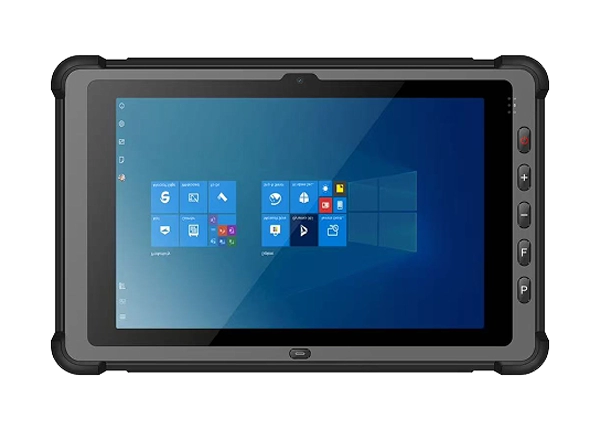
For these applications, the RT-10NF 10-inch Windows 10/11 Rugged Tablet provides a portable Windows computing platform with multiple wired and wireless connection options.
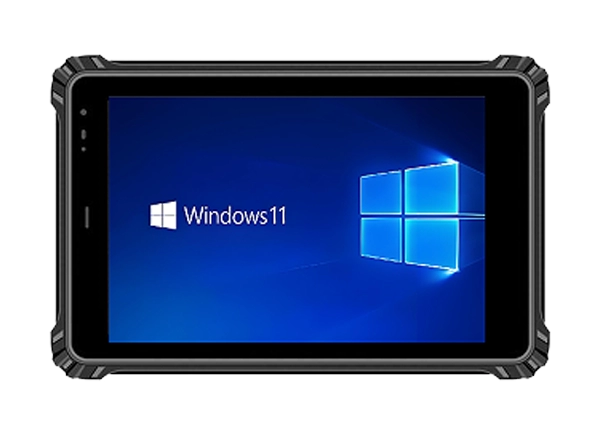
Many industrial environments already rely on Windows-based software for equipment management, production monitoring, maintenance, and data collection. Replacing an existing system simply to accommodate a new mobile terminal may create unnecessary software migration and integration work.
A Windows rugged tablet can help extend existing workflows to mobile operations, provided that the required software, drivers, and communication interfaces are compatible with the tablet's hardware and operating system.
The RT-10NF uses an Intel Celeron N5100 processor with four cores and four threads, operating at 2.20GHz to 2.80GHz. It supports Windows 10 and Windows 11 and is available in several memory and storage configurations:
· 8GB RAM with 128GB storage.
· 16GB RAM with 128GB storage.
· 16GB RAM with 256GB storage.
These options allow project teams to select a configuration according to their application requirements. A terminal running a basic equipment interface may have different resource needs from one handling multiple applications, local records, and communication tools at the same time.
Before deployment, buyers should verify the software's operating system requirements, processor compatibility, display scaling, driver availability, and connection protocols. Windows compatibility alone does not guarantee that every industrial controller or peripheral can communicate directly with the tablet.
A mobile HMI is only useful when it can exchange information with the equipment and systems involved in the workflow. Interface selection should therefore be part of the terminal evaluation process.
The RT-10NF provides several physical connection options for different integration requirements.
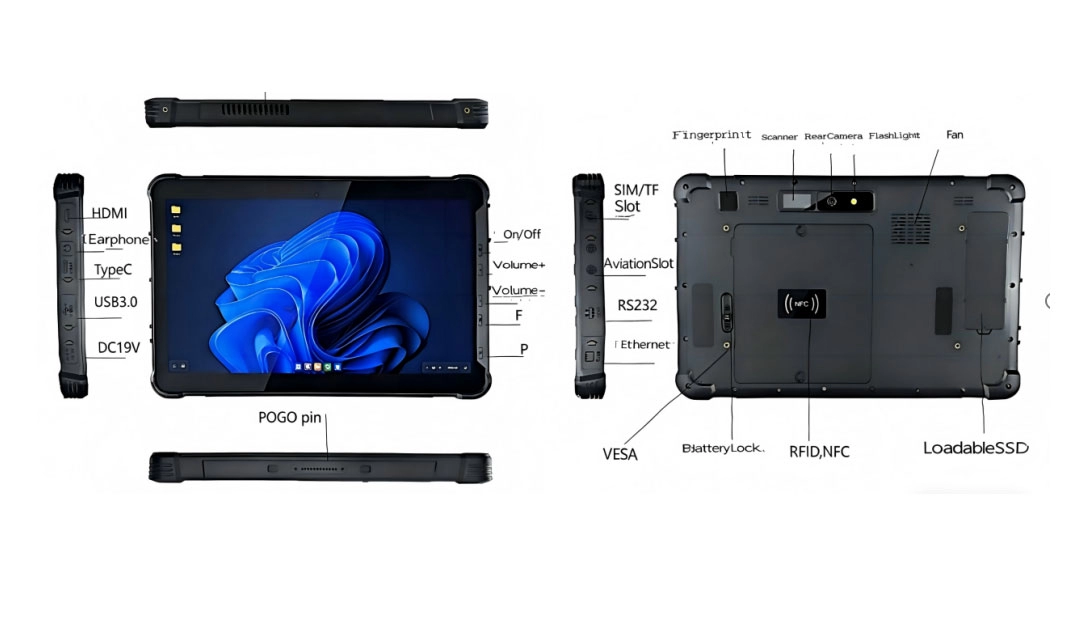
Its USB Type-A and Type-C ports support USB 2.0 connections, which can be used with compatible peripherals such as storage devices, input equipment, and selected industrial accessories. The Micro HDMI interface provides an option for connecting an external display when a larger viewing area is required.
For environments where a stable wired network is preferred, the tablet includes a 100Mbps Ethernet port. This can be useful when connecting to a local industrial network, accessing network-based applications, or transferring information within a facility. Actual communication with PLCs, controllers, or other equipment depends on the network architecture, software, and supported protocols.
The 12-pin Pogo Pin interface also provides a potential connection point for compatible docking or customized accessory solutions. For projects involving dedicated mounting systems or peripheral integration, buyers should confirm the pin definition, electrical requirements, and accessory compatibility with the manufacturer before finalizing the design.
When evaluating a rugged tablet factory, it is worth asking not only which ports are available, but also whether the manufacturer can clarify interface specifications and support project-specific integration requirements.
Not every industrial operation can rely on a fixed Ethernet connection. Maintenance teams, inspection personnel, and mobile operators may need to access information while moving between equipment areas.
The RT-10NF supports Wi-Fi using 802.11a/b/g/n/ac standards across 2.4GHz and 5.8GHz frequencies. Bluetooth 5.1 with BLE support provides another option for connecting compatible wireless peripherals over short distances.
A GPS module is supported for applications that require location information. Optional 4G or 5G communication can provide cellular connectivity where suitable network coverage and service are available.
These capabilities can support mobile workflows such as equipment inspection, field service, vehicle-based operations, and remote access to authorized business applications. However, the exact communication method should be selected according to site coverage, network security policies, data requirements, and the capabilities of the connected system.
For a mobile HMI project, wireless connectivity should complement—not replace—the communication architecture required by the industrial equipment.
Operators may need to interact with an HMI while standing beside machinery, moving through a facility, or working in areas without a dedicated workstation. Screen usability therefore affects how efficiently they can access information.
The RT-10NF features a 10-inch LCD screen with a standard resolution of 800 × 1280. A 1200 × 1920 resolution option is available for projects that require a higher pixel density. The standard brightness is 500 nits, with optional 800-nit and 1000-nit configurations for different lighting conditions.
Its 10-point capacitive touch panel has a surface hardness rating of 7H. This supports touch-based interaction with compatible Windows applications, including navigation, data entry, and on-screen controls.
For outdoor or high-illumination environments, buyers should evaluate the selected brightness configuration under actual working conditions. They should also consider application font sizes, button spacing, and screen layouts to ensure that important HMI information remains easy to read and operate.
Industrial projects often require functions beyond standard computing and network access. The RT-10NF supports optional modules that can be selected according to the intended application.
Available options include 1D and 2D barcode scanning, RFID, NFC, HF and LF modules, as well as fingerprint recognition modules. Supported contactless protocols include 14443A, 14443B, 15693, and 125K, depending on the selected module.
These options can help extend a mobile terminal into a specialized field device. For example, barcode scanning can assist with equipment identification, RFID can support asset-related workflows, and fingerprint recognition can be considered for applications requiring an additional identity-verification function.
The front 5MP and rear 8MP cameras can also support image capture in inspection and documentation workflows. Before ordering, project teams should confirm the required module type, protocol, software interface, and physical configuration. Optional hardware should be matched to the actual application rather than selected simply because it is available.
Choosing an industrial tablet involves more than comparing processor and memory specifications. Buyers also need to evaluate whether the manufacturer understands the operating environment, hardware integration requirements, and long-term application needs.
A capable rugged tablet factory should be able to explain its product configurations, clarify optional module specifications, and provide practical information about interfaces and environmental protection. For customized projects, communication about mounting, accessories, module selection, and system compatibility is particularly important.
Fushizk Technology Co., Ltd. is a technology enterprise established in 2021 in Shenzhen, China, integrating research and development, production, and sales. Its rugged computing portfolio includes Android and Windows tablets, vehicle-mounted tablets, medical rugged tablets, explosion-proof models, and reinforced tablets for specialized applications.
The company identifies embedded system development, AI algorithm optimization, and wireless communication technology as its three core technical areas. It has applied for more than 50 patents, with annual R&D investment exceeding 15% of its revenue. Its product development and manufacturing activities serve application areas including factory automation, mechanical automation, medical devices, transportation, energy, and outdoor inspection.
For buyers evaluating a rugged tablet factory, these capabilities provide useful points for discussing product customization and project requirements. Fushizk's RT-10NF can be considered for mobile HMI projects that need Windows compatibility, multiple connection interfaces, optional identification modules, and a portable form factor.
Before introducing a Windows rugged tablet into an industrial environment, project teams should define the equipment to be connected, the software to be operated, and the information that users need to access. They should then verify communication protocols, network permissions, peripheral drivers, and the required hardware configuration.
Environmental conditions also need attention. The RT-10NF has an IP67 protection rating, an operating temperature range of -20°C to 60°C, and a stated 1.2-meter drop-resistance specification under the manufacturer's test conditions. Its built-in 7.6V, 6000mAh battery has a stated runtime of approximately eight hours under a specific local 1080P video playback test condition. Actual runtime will vary with application load, screen brightness, wireless activity, and peripheral use.
A successful mobile HMI deployment depends on matching the terminal to the complete working process—not simply choosing a device with a rugged enclosure. With suitable software validation, interface planning, and hardware configuration, theRT-10NF Windows Rugged Tablet can serve as a flexible mobile computing terminal for industrial equipment access and field operations.
For projects requiring a Windows-based mobile HMI, the RT-10NF 10-inch Rugged Tablet offers a combination of computing performance, wired and wireless connectivity, and optional expansion modules. Working with an experienced rugged tablet factory can also help buyers clarify configuration details before moving from product evaluation to project deployment.